When I review websites that struggle to rank, one pattern shows up repeatedly.
The issue is rarely the keywords themselves.
More often, the content is answering a different question than what people are actually searching for. The page might be well-written, technically sound, and even optimized on paper, but it still fails to perform because it does not match the intent behind the search.
This is where search intent becomes important.
Understanding search intent in SEO is not just part of optimization. It is the foundation that determines whether your content aligns with real user expectations or gets ignored entirely.
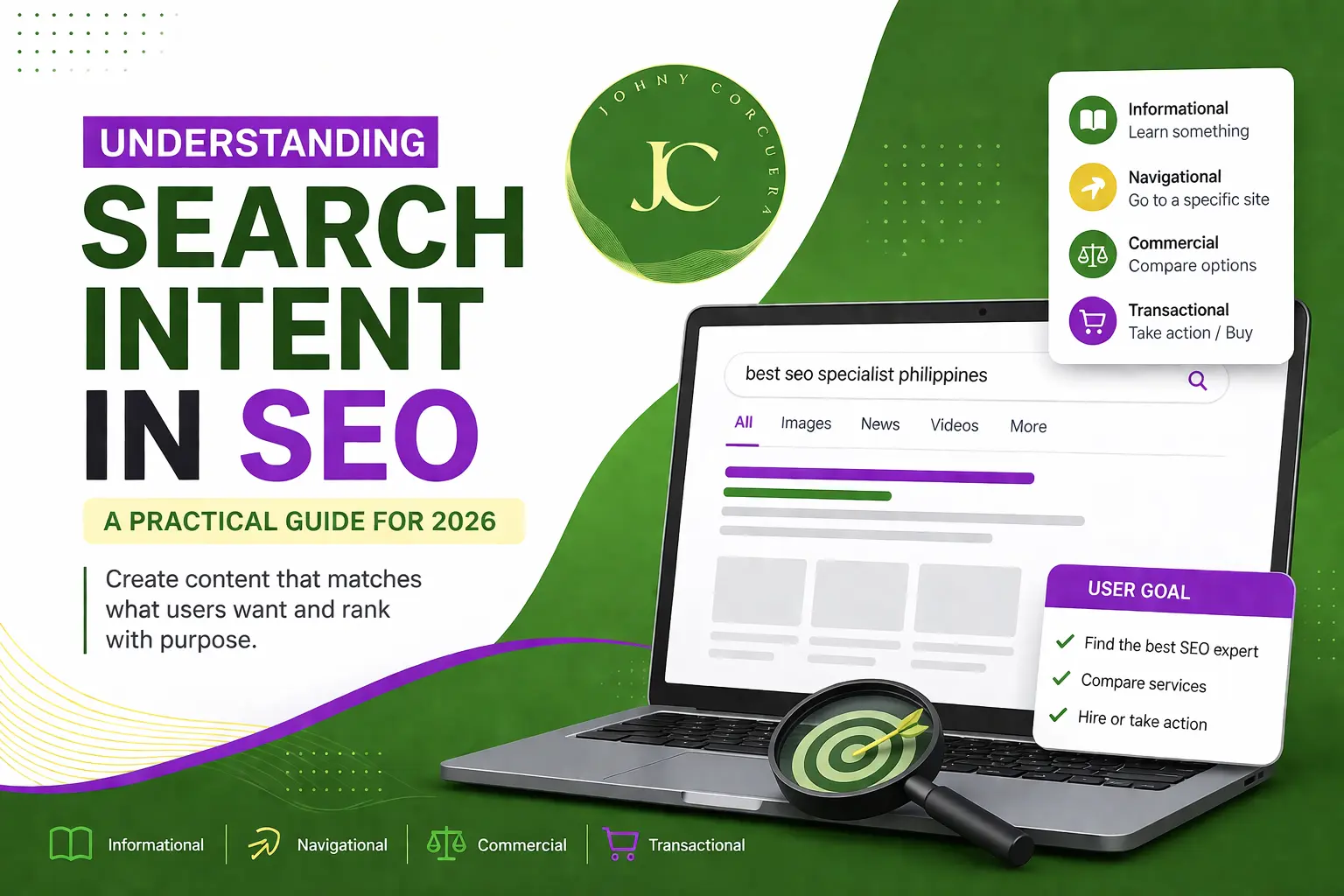
Search intent in SEO refers to the reason behind a search.
In simple terms, what search intent is comes down to what users are actually trying to accomplish when they type a query into Google.
It is not just what users type, but what they expect to find.
For example, someone searching for “what is SEO” is looking to understand a concept. Someone searching for “SEO services Philippines” is already considering hiring.
The keywords may seem related, but the expectation behind each search is completely different.
In practice, this is where many websites go wrong. They target the right keyword but create content that does not match what the user is actually trying to find.
There was a time when ranking could be influenced heavily by keyword placement.
That is no longer how search works.
Today, Google focuses on relevance and usefulness. If a page does not satisfy the intent behind a query, it will struggle to rank no matter how well it is optimized.
In SEO, search intent is often referred to as user intent. Understanding user intent in SEO allows content to match real search behaviour rather than just keywords.
From experience, I have seen pages improve significantly not by adding more content, but by adjusting the direction of the content itself.
When intent is aligned correctly:
When intent is misaligned:
This is why search intent is often the difference between traffic and meaningful results.
Understanding the types of search intent helps you match your content with what users actually expect to find.
Search intent is commonly grouped into four main types. These are useful as a starting point, but they should not be treated as rigid categories.
The user wants to learn something.
Examples:
Content for this intent should focus on clarity and explanation. Trying to sell too early here usually does not work.
The user is comparing options before making a decision.
Examples:
This is where users are evaluating. Content here should help them understand differences and make informed choices.
The user is ready to take action.
Examples:
This is where service pages and landing pages perform best.
The user is looking for a specific website or page.
Examples:
This type of intent is usually brand-driven. There is little room to compete unless you are the destination.
One mistake I often see is treating search intent as fixed.
In reality, intent can overlap.
A search like “best SEO tools” may include:
Similarly, “SEO services Philippines” may include:
Understanding this overlap helps you create content that answers more than one layer of intent without forcing it.
Search engines no longer rely only on keywords.
They analyze:
This is why looking at the search results themselves is one of the most reliable ways to understand intent.
Google has already done the interpretation. Your job is to understand what those results are telling you.
A practical way to understand intent is through three elements:
Is it a blog post, product page, service page, or tool?
Is it a guide, list, comparison, or tutorial?
What makes the content relevant right now?
Is it updated, simplified, or focused on a specific audience?
When these three align with what appears in search results, your content has a much better chance of performing.
There are a few reliable ways to determine intent without relying on guesswork.
Search your target keyword and review the top pages.
Pay attention to:
This gives you a clear idea of what users expect to see.
Certain words indicate intent.
Even small differences in phrasing can change intent entirely.
If multiple top-ranking pages follow the same format, it is usually not a coincidence.
It means that format satisfies the intent.
Optimizing for intent is not about adding more keywords. It is about aligning your content with what users expect.
This involves:
Search intent also plays a key role in modern SEO content strategy, especially as search systems continue to evaluate relevance based on user behavior.
This is also where keyword research becomes more effective when combined with intent, not used in isolation.
From experience, these are some of the most common issues:
These issues are often subtle, but they have a strong impact on performance.
Search intent is not just about rankings.
It directly affects how users interact with your site.
When intent is aligned:
When intent is ignored:
This is why improving intent alignment often leads to more stable and long-term growth.
SEO is not just about visibility. It is about understanding what people are actually searching for and making sure your content matches that expectation clearly.
In many cases, pages struggle not because the topic is weak, but because the intent behind the content does not align with what users expect to find.
Once search intent becomes clearer, it becomes easier to structure content, target the right queries, and build pages that perform more consistently over time.
If you want to continue learning about practical SEO strategies, you can explore more practical SEO insights across the blog.
Local Events
Private Events